Against the backdrop of the global push for “carbon neutrality” and sustainable development, the treatment and resource recovery of plastic waste have become a central focus for both the plastics processing and environmental protection industries. Every year, millions of tons of waste plastic films, trash bags, industrial packaging films, and agricultural films are discarded or sent to landfills, resulting in significant resource waste and placing immense pressure on the environment.
However, plastic manufacturers and recyclers often face numerous challenges when attempting to reintroduce waste materials directly into the production line:
Loose material form: Film waste is bulky yet low-density; direct feeding is highly inefficient and prone to clogging equipment.
Uneven melting and plasticizing: Standard equipment struggles to process film waste containing impurities or varying thicknesses, resulting in poor-quality pellets with voids.
High costs of traditional water-cooled pelletizing: Conventional water-cooled strand pelletizing requires vast amounts of cooling water—increasing water consumption and wastewater treatment costs—while the subsequent drying stage significantly drives up electricity consumption.
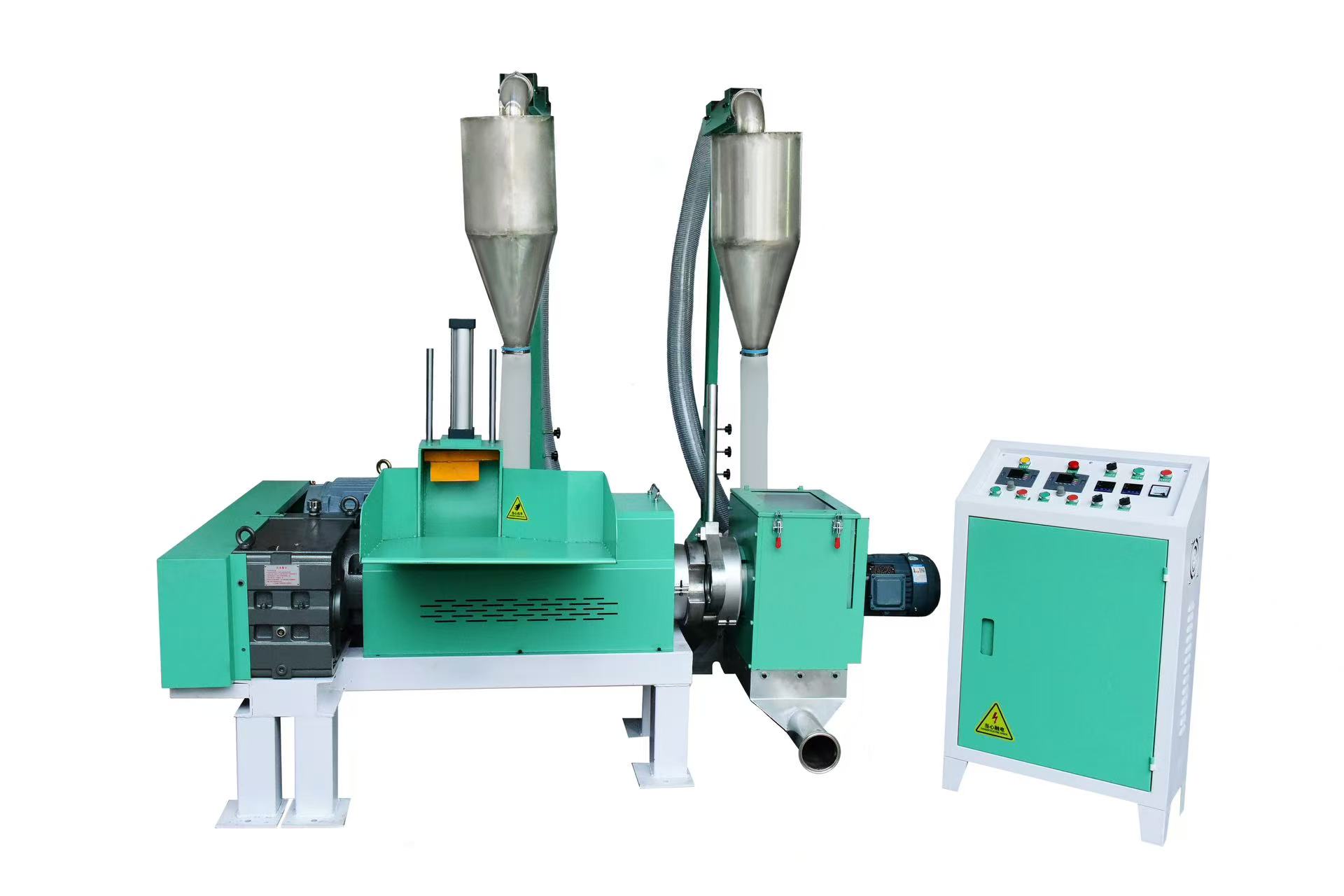
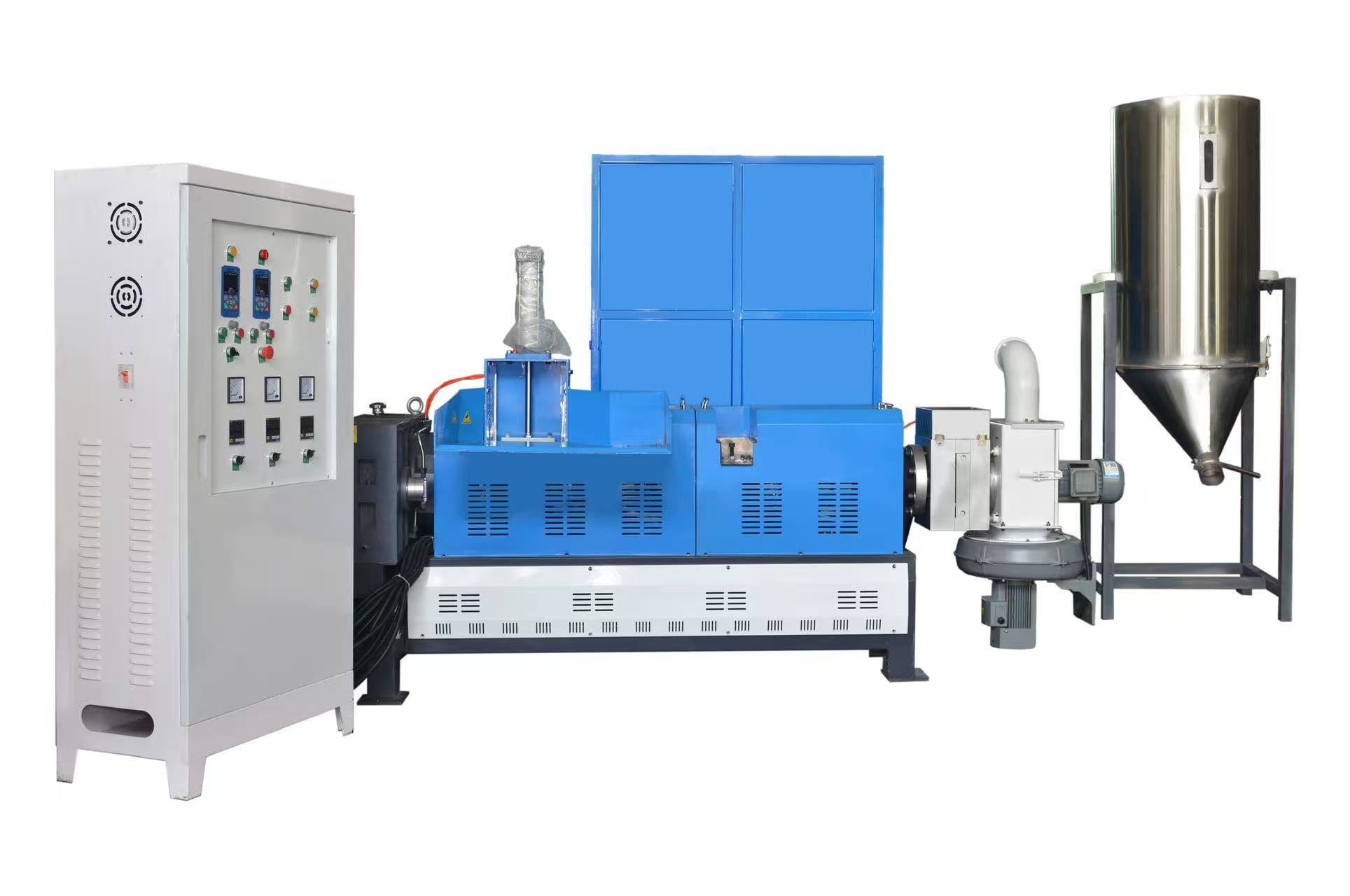
To comprehensively address these challenges, we have launched a new generation of air-cooled hot-die face cutting plastic recycling and pelletizing systems. Utilizing an integrated, high-efficiency pelletizing process, the system directly converts waste plastic films into uniform, dense, and high-quality black recycled plastic pellets, enabling customers to achieve cost-effective, high-efficiency waste recycling and resource recovery.
1 High-pressure resistant die head and air-cooled hot-die face cutting
2 Efficient raw material feeding and forced extrusion
3 Precise temperature control and efficient melting/plasticizing
This air-cooled hot-die face cutting plastic pelletizer offers outstanding technical and economic advantages:
1. Water-free operation: Energy-efficient and eco-friendly
Traditional water-cooled pelletizing consumes large quantities of cooling water, incurs high energy costs during the drying phase, and generates wastewater pollution. The air-cooled hot-die face cutting system utilizes airflow for both cooling and conveying, eliminating the need for water pools or troughs. This saves water resources and treatment costs at the source while removing the need for high-energy-consuming equipment like dryers, resulting in an overall electricity saving of 15%–25%. 2. High level of automation, saving labor costs
The entire unit integrates forced feeding, plasticizing extrusion, die-face hot cutting, air-conveying cooling, and finished product bagging. Only 1–2 operators are required to maintain efficient operation of the entire line, significantly reducing factory labor costs.
3. Excellent pellet appearance and high density
Die-face hot cutting ensures uniform pellet shapes and smooth cut surfaces. Pelletizing in the molten state followed by air cooling avoids issues associated with water cooling—such as hollow cores, residual moisture, or agglomeration—thereby greatly improving the bulk density and reprocessing flowability of the recycled pellets.
4. Strong material adaptability
This equipment is particularly suitable for the efficient pelletizing of waste plastic films (PE, PP, LDPE, LLDPE, etc.), agricultural films, shopping bags, garbage bags, bubble wrap, and various types of scrap materials.
5. Modular design and durability
The extruder screw and barrel are made of high-quality alloy steel (e.g., 38CrMoAlA) and treated with nitriding or bimetallic spraying, ensuring wear and corrosion resistance. The high-pressure resistant die head design allows for prolonged, continuous operation under high pressure; the equipment runs smoothly with low noise and a very low failure rate.
The black recycled pellets (PE/PP) produced by this equipment exhibit excellent performance and can be widely used directly in the secondary processing of various plastic products:
Film blowing: Can be mixed with virgin material at specific ratios (or used as 100% recycled material) to produce industrial packaging bags, garbage bags, construction films, agricultural mulch films, etc.
Injection molding: Widely used to manufacture industrial and consumer injection-molded products such as plastic pallets, trash cans, pipe fittings, automotive plastic parts, agricultural irrigation components, etc.
Extruded piping: Used to produce corrugated pipes, agricultural drainage pipes, power cable conduits, etc.
Sheets and blow-molded containers: Suitable for plastic sheet extrusion and the blow molding of medium-sized, non-food-grade plastic containers.
Please contact me if you are interested.